
Novel Naphthyl Bioisostere for Your Med-Chem Toolbox
What do FDA approved drugs propranolol, naproxen and terbinafine have in common? They all contain a naphthalene moiety, which is a common structural motif in biologically active compounds.
The reasons are perhaps clear to most medicinal chemists. Naphthalene fits well into many lipophilic pockets on proteins, many functionalized derivatives of naphthalene are commercially available and inexpensive, and its chemical modification, e.g. via cross coupling chemistry, is often high-yielding as there are no hetero-atoms that would complicate the life of a synthetic chemist or the catalytic cycle of a transition metal.
However, naphthalene has its own pitfalls. Its flat aromatic and lipophilic structure can negatively impact physicochemical properties of the molecule, sometimes leading to poor aqueous solubility. Another potential issue is a metabolic liability. CYP enzymes (especially CYP1A and CYP1B subfamilies) can oxidize the naphthalene moiety into a reactive 1,2-naphthalene oxide, which can form reactive electrophilic naphthoquinones that can bind to off-target biomolecules and cause toxicity.
To tackle this issue, a team led by Angela J. Russell at the University of Oxford explored a novel bioisostere of naphthalene and published their work in Nature Chemistry.
Aryl-fused carbon cage as naphthalene bioisostere
There are numerous possibilities how medicinal chemists can approach bioisosteric replacement of naphthyl (Fig 1a). Yet, in order to balance the phys-chem properties as well as biological activities, every novel structural motif is well appreciated. Inspired by bicyclic phenyl bioisosteres (Fig 1b), the authors introduce an aryl-fused bicyclo[3.1.1]heptane, or BCHep (Fig 1c), which has been so far only sporadically described in patent literature or virtual libraries.
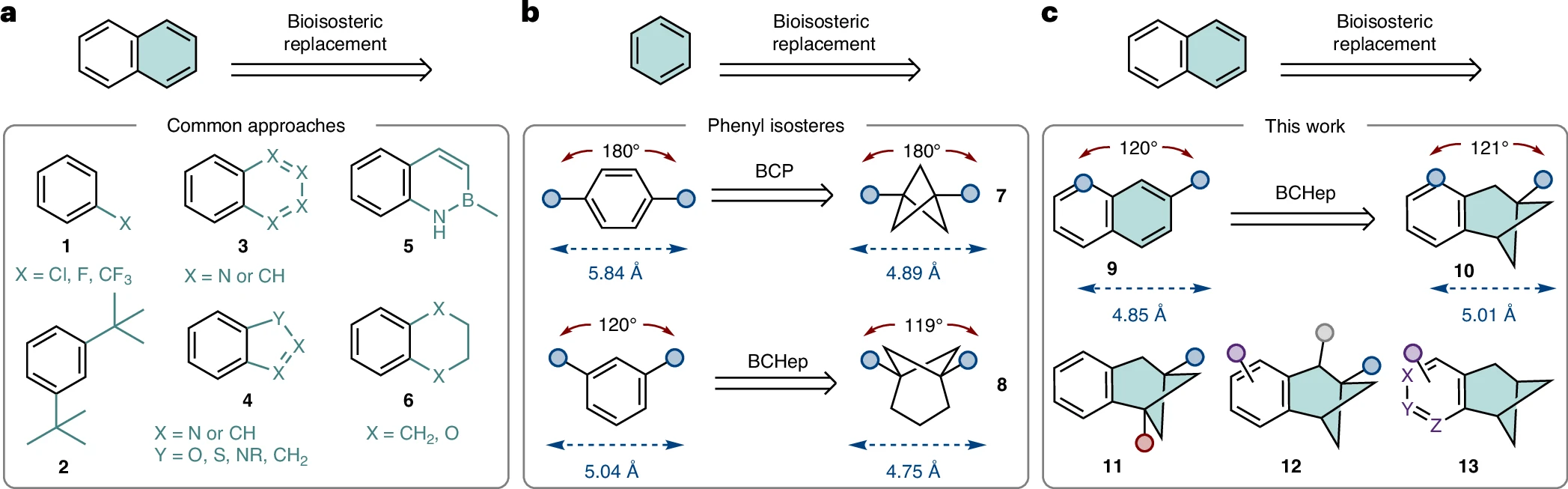
This builds on earlier work by Anderson and coworkers, who showed the plain BCHep is a good stand-in for a meta-substituted benzene (much like the popular bicyclo[1.1.1]pentane stands in for a para-substituted one). The novelty of this approach is in fusing an arene onto the carbon cage.
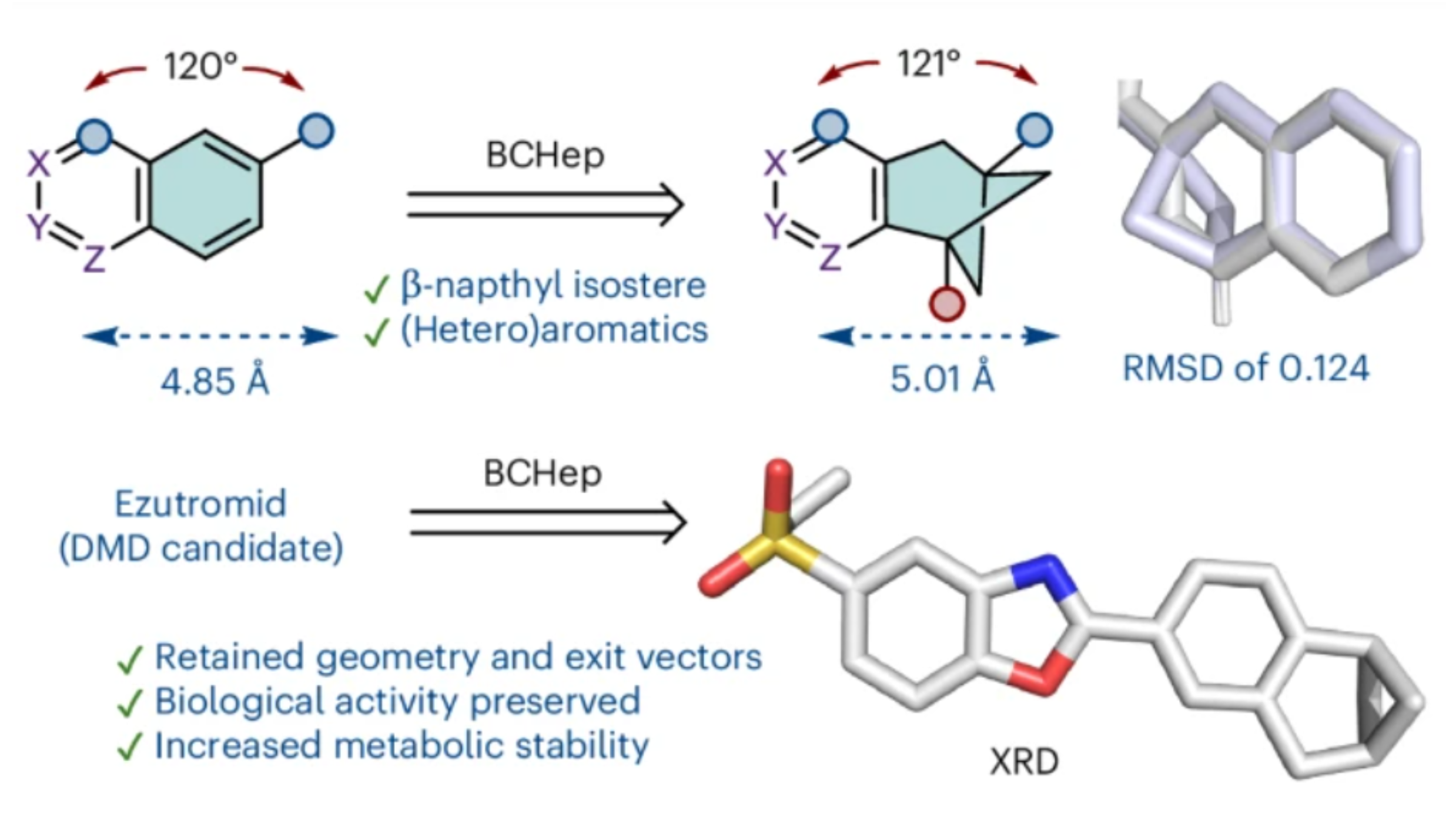
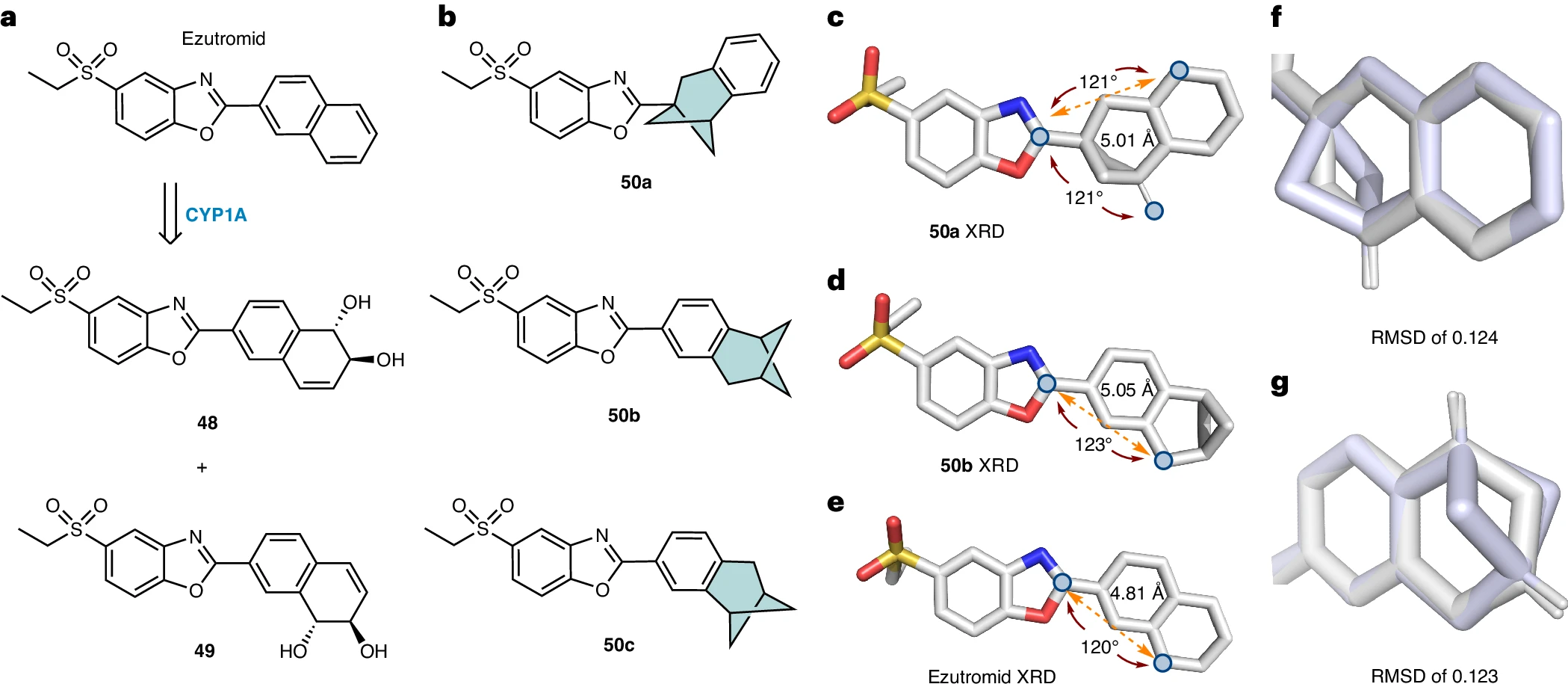
Using X-ray crystallography, the authors demonstrate that the bridgehead angle is held at 119 to 121 degrees and is essentially unchanged by fusing on the arene. Overlaying the BCHep cage onto the naphthyl ring shows excellent geometrical overlap, where only the cyclobutyl ring is pointing out of the planar structure. Importantly, the meta-substitution at the bridgehead atoms retains very similar geometry.
Synthesis of aryl-fused bicyclo[3.1.1]heptane (BCHep)
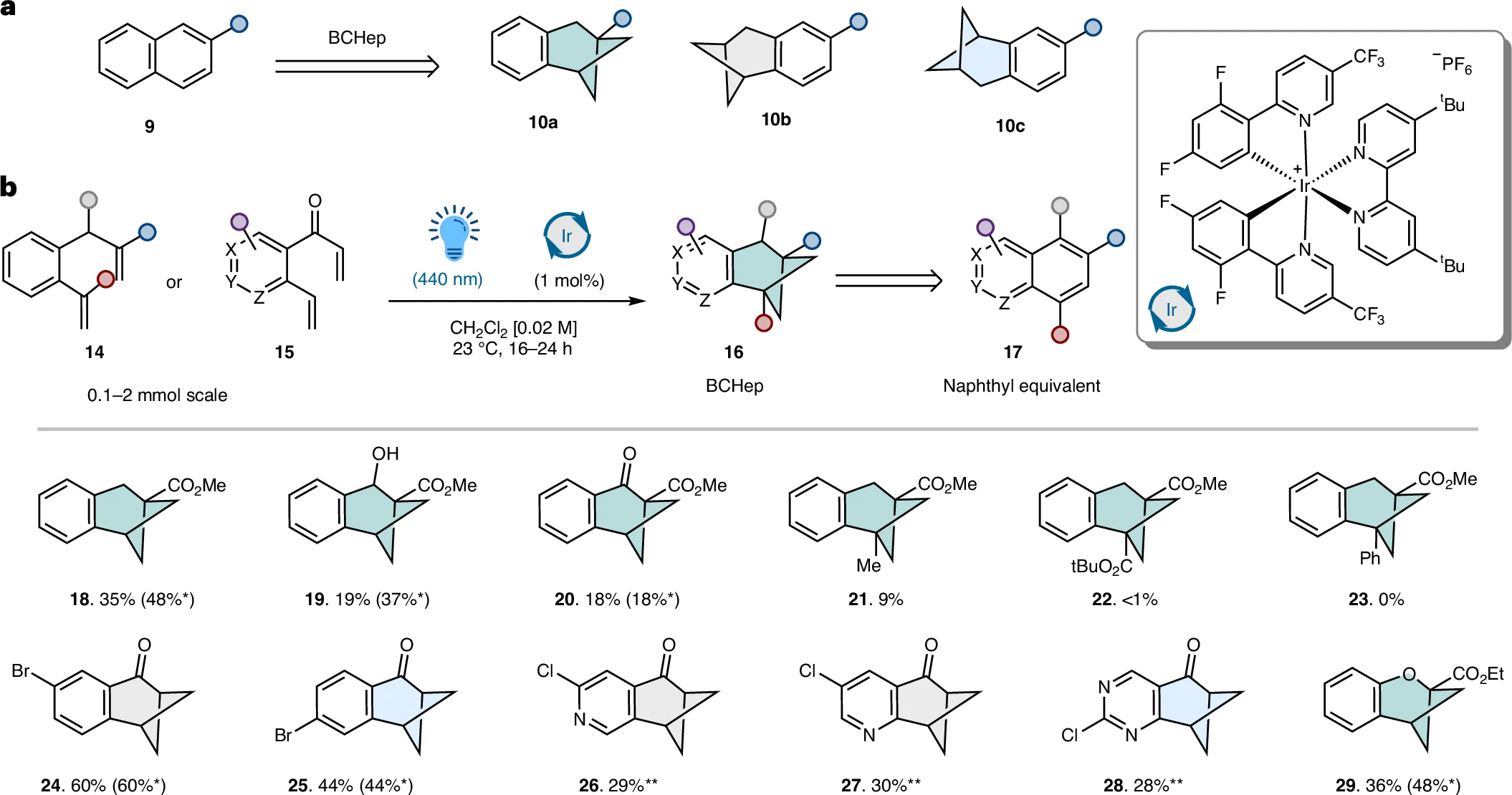
When you tell me to make a cyclobutyl ring, the first approach I would think about is 2+2 photocycloaddition. And this is what also the authors chose to assemble the bicyclic cage, using an iridium photocatalyst, 440 nm visible light and a divinyl precursor.
Initially, the reaction gave poor yields, likely due to oligomerization. This issue was resolved by adding a small amount of pyrene as a triplet-triplet annihilation upconverter, steering the substrate into the singlet excited state needed for clean ring closure, which improved the yields.
In case of pyridine-based substrates, the reaction didn’t work at all until the authors observed that addition of diphenyl phosphoric acid (25 mol%) provides poor but workable yields around 30%, opening the door to quinoline, isoquinoline, and quinazoline isosteres. The authors speculate that diphenyl phosphoric acid protonates the pyridine nitrogen, which otherwise interferes with the reaction.
Using the optimized reaction conditions, the authors prepared a range of aryl-fused BCHeps with various substitution patterns.
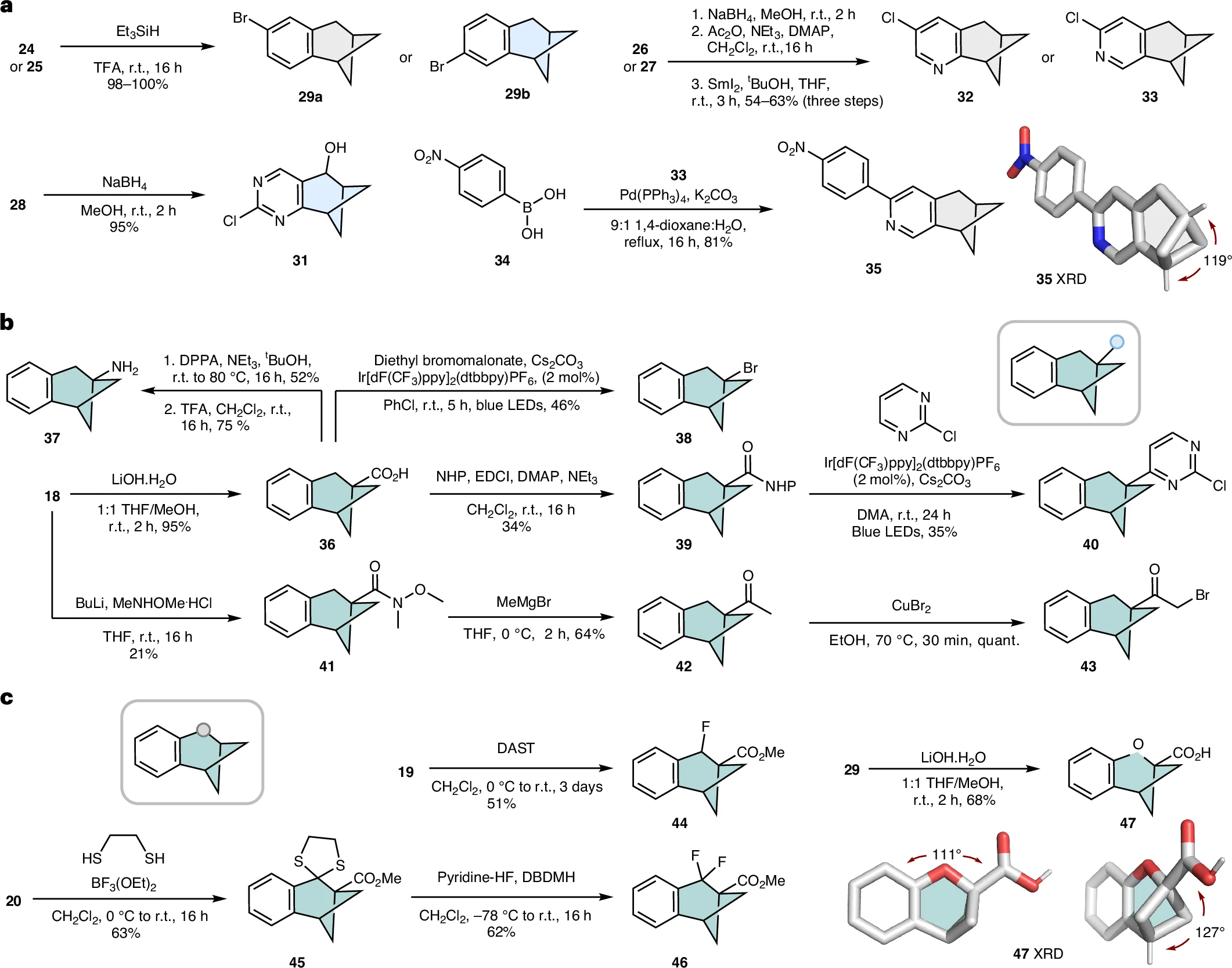
With the aryl-fused BCHeps in hand, the authors set out to show how readily these scaffolds can be elaborated into a diverse set of building blocks.
Starting on the aromatic ring, they reduced aryl ketones to halide-bearing partners primed for cross-coupling, while the heterocyclic derivatives called for a reduction-then-deoxygenation sequence. To prove the chemistry was compatible with the cage, they subjected the isoquinoline analogue to Suzuki coupling providing a crystalline nitroarene, whose X-ray bridgehead angle of 119° matched Anderson’s original BCHep frameworks, confirming that fusing on an arene leaves the bridgehead geometry intact.
Attention then turned to the bridgehead position, which was successfully decorated with carboxylic acid, primary amine, Weinreb amide and bromide. This allowed generation of additional analogues such as a ketone and then a bromoketone, handy for building heterocycles. Mono- and difluoro derivatives at the benzylic CH₂ position were prepared to blunt CYP-mediated oxidation. Replacing one benzylic carbon for oxygen contracting the β-naphthyl angle from 120° to 111° and widening the angle between bridgehead positions to 127°.
Rescuing ezutromid
The team redesigned ezutromid, drug candidate which failed phase 2 trials due to metabolic liability of the naphthyl moiety. with the naphthalene swapped for their new bioisostere, resulting in analogues 50a, 50b, and 50c, and tested them against ezutromid’s primary target, the aryl hydrocarbon receptor (AhR).
Although all three analogues exhibit lower activity (the best analogue, 50b, shows 2.12 uM IC50), the main headline is the metabolism. In mouse liver microsomes, 50a roughly doubled ezutromid’s half-life (94 versus 60 minutes). Notably, adding a CYP1A inhibitor did not change the half-life, suggesting that they bypass the exact metabolic pathway that doomed ezutromid’s clinical trials.
My opinion
This work represents a comprehensive bioisostere story. The authors show close geometrical alignment between naphthyl and aryl-fused bicyclo[3.1.1]heptane by X-ray crystallography, established synthesis and further derivatization and demonstrated that the replacement actually solves the metabolic flaw that killed the original drug ezutromid.
The yields are not great (Figure 2), around 50% in the better cases. But I believe that there is room for improvement.
I think aryl-fused BCHeps deserve a spot in the toolbox. Naphthalene, quinoline, and quinazoline show up in so many programs, and a geometry-matched, sp3-rich replacement that dodges CYP1A oxidation could rescue good molecules with a metabolic weak spot.
The next quest is probably hanging in the air. Which is making additional (hetero)aromatic scaffolds by BCHep incorporation.
Share your thoughts
What is your favourite naphthyl bioisostere?
How would you optimize the yields of the aryl-fused bicyclo[3.1.1]heptane synthesis?
Leave your comments under my LinkedIn post here.
Full paper: https://doi.org/10.1038/s41557-026-02129-2