
Catching a Nascent Radical in a Picosecond for Stereoretentive sp3-sp3 Radical-Radical Cross-Coupling
Some problems in chemistry are so old that we stopped challenging them and accepted them as facts of life. A good example is the epimerization of a chiral centre upon formation of a radical. Take a single enantiomer, make a radical at the chiral centre (often a carbon atom), and within picoseconds the optical purity is gone, generating a 50:50 mixture of stereoisomers because the radical centre inverts almost freely.
Till now, synthetic chemists built an arsenal of methods to work around it, quietly accepting the limitation.
A new paper in Science from Phil Baran’s group at Scripps Research, led by Yu Wang, Jiawei Sun and co-workers (with a contribution from Pfizer), set out to challenge it. They report a scalable, stereoretentive radical-radical cross-coupling of two distinct, transient alkyl radicals, one derived from an enantioenriched sulfonylhydrazide and achiral primary and secondary alkyl halides, achieved without chiral ligands, directing groups, or exogenous redox agents.
The challenge of sp3-sp3 radical-radical cross-coupling
The saturated sp3-rich scaffolds are present in many small molecules including natural products, pharmaceuticals or advanced materials. Connecting two sp3 carbons via cross-coupling is often nontrivial. Metal-catalysed routes stall on beta-hydride elimination and sluggish reductive elimination. Radical routes have another issue: two radicals couple indiscriminately, contaminating the product with two homodimers. Adding stereocontrol on top of that then amplifies the challenge to another level.
The key idea: Capture the chiral centre in solvent cage
The clever move is to store the stereochemistry in one radical precursor, not in a chiral catalyst. That precursor is a sulfonylhydrazide made from a cheap, enantiopure amine. Base activation sheds a diazene, which extrudes nitrogen gas and frees the carbon radical at the former chiral centre. Everything then hinges on timing. Before the nascent radical can flip and change its configuration, it is locked for a short moment in the solvent cage just next to the nickel catalyst. This very short window was, however, enough for the authors to fine-tune the reaction conditions so that before the radical can diffuse out and invert, nickel grabs it back, locking in the configuration as a chiral nickel-carbon intermediate.
The second coupling partner is an ordinary achiral alkyl halide which undergoes halogen atom transfer (XAT) resulting in a carbon radical. This alkyl radical then adds to the chiral nickel(II) complex, giving a nickel(III) species with both alkyl groups. Reductive elimination then forges the C(sp3)-C(sp3) bond. Importantly, the sequence works only if the two events are kinetically matched, so the chiral nickel (II) species is ready when the second radical appears. Respecting the redox cycle of nickel, a tridentate (three-armed) ligand, while the earlier alkyl-aryl coupling used a bidentate one.
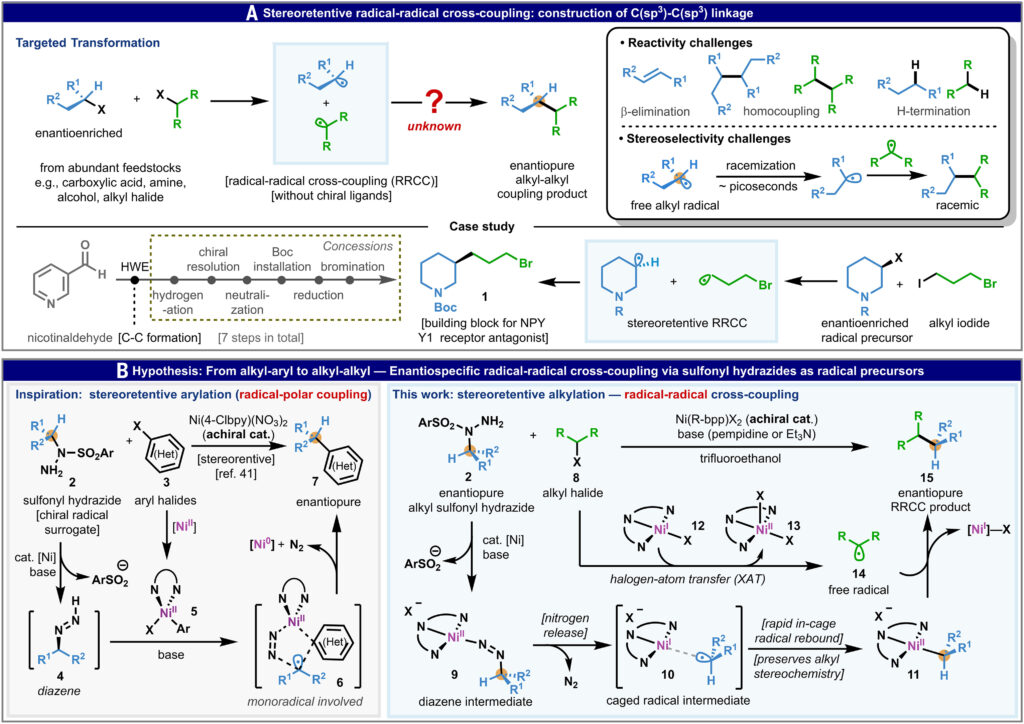
(A) Precedent and challenges of the targeted transformation, RRCC, with a case study of a potential RRCC application. (B) Hypothesis of stereoretentive RRCC of alkyl sulfonylhydrazides to make C(sp3)–C(sp3) bonds. Boc, tert-butoxycarbonyl.
Getting the conditions right
To prove that the hypothesis can be turned into satisfying yields the authors performed high-throughput screening to find a suitable reaction conditions. As a model substrate, the authors chose enantioenriched piperidine and pyrrolidine decorated with sulfonylhydrazide, which represent chemical scaffolds of high relevance and demand in medicinal chemistry, which are often difficult to make in optically pure form. The multi-parameter optimization of Ni catalyst, solvent, base, and hydrazide demonstrated a complex interplay between these variables. Of note, the conditions from the earlier radical arylation work gave a meagre 6% yield. The biggest improvement was achieved by removing the protecting group from piperidine entirely, which pushed the enantiospecificity (e.s.) to 94%. In the case of pyrrolidine, PMP has been identified as optimal protecting group. The final reaction conditions are depicted in Fig. 2.
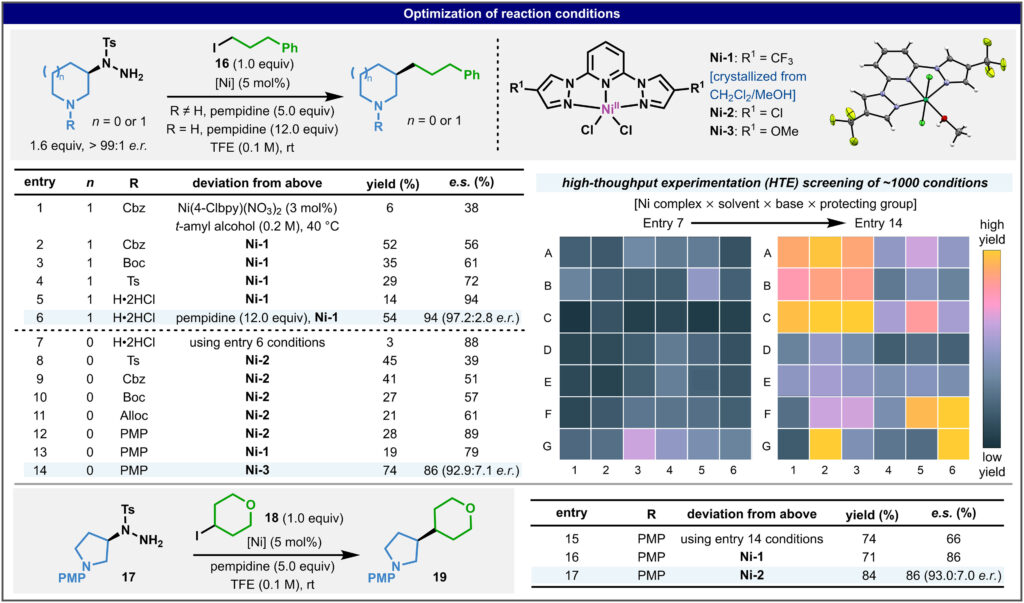
bpy, 2,2’-bipyridine; Cbz, benzyloxycarbonyl; Ts, p-toluenesulfonyl; Alloc, allyloxycarbonyl; rt, room temperature.
Substrate scope and functional group tolerance
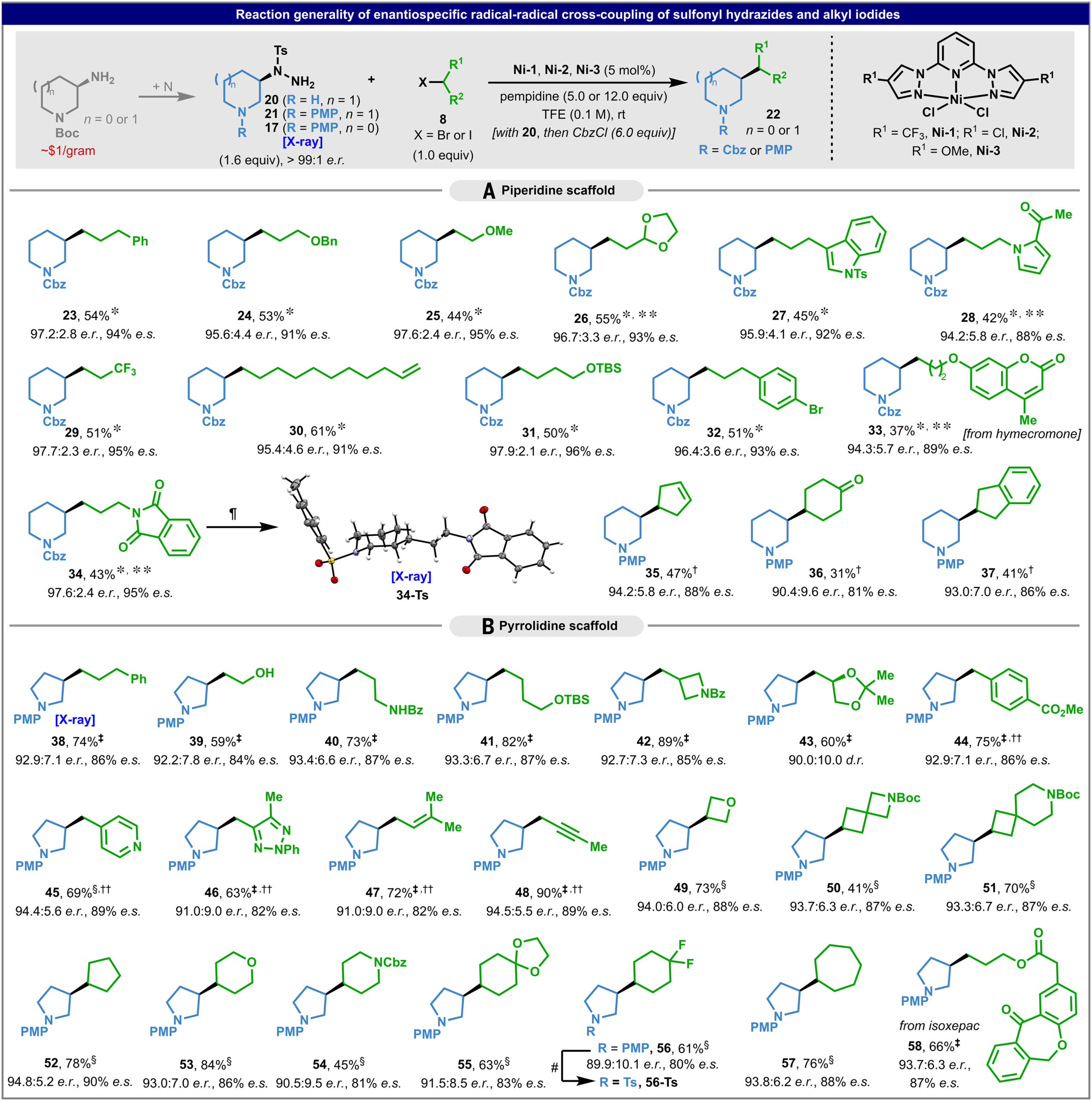
The scope is relatively broad for radical based mechanism. Across piperidine and pyrrolidine scaffolds, yields generally fall between 40 and 90%, with enantiospecificity from 80 to 96%. The reaction tolerates ethers, acetals, heterocycles, trifluoromethyl groups, terminal olefins, protected alcohols, free amines, and even sensitive coumarins and phthalimides. Remarkably, the protocol also works with secondary alkyl iodides, connecting two transient secondary radicals, hard to do without directing groups (in this case, PMP as protecting group on piperidine’s NH is needed).
Trifluoroethanol also stops the free amine alkylating itself, so many substrates need no protecting group.
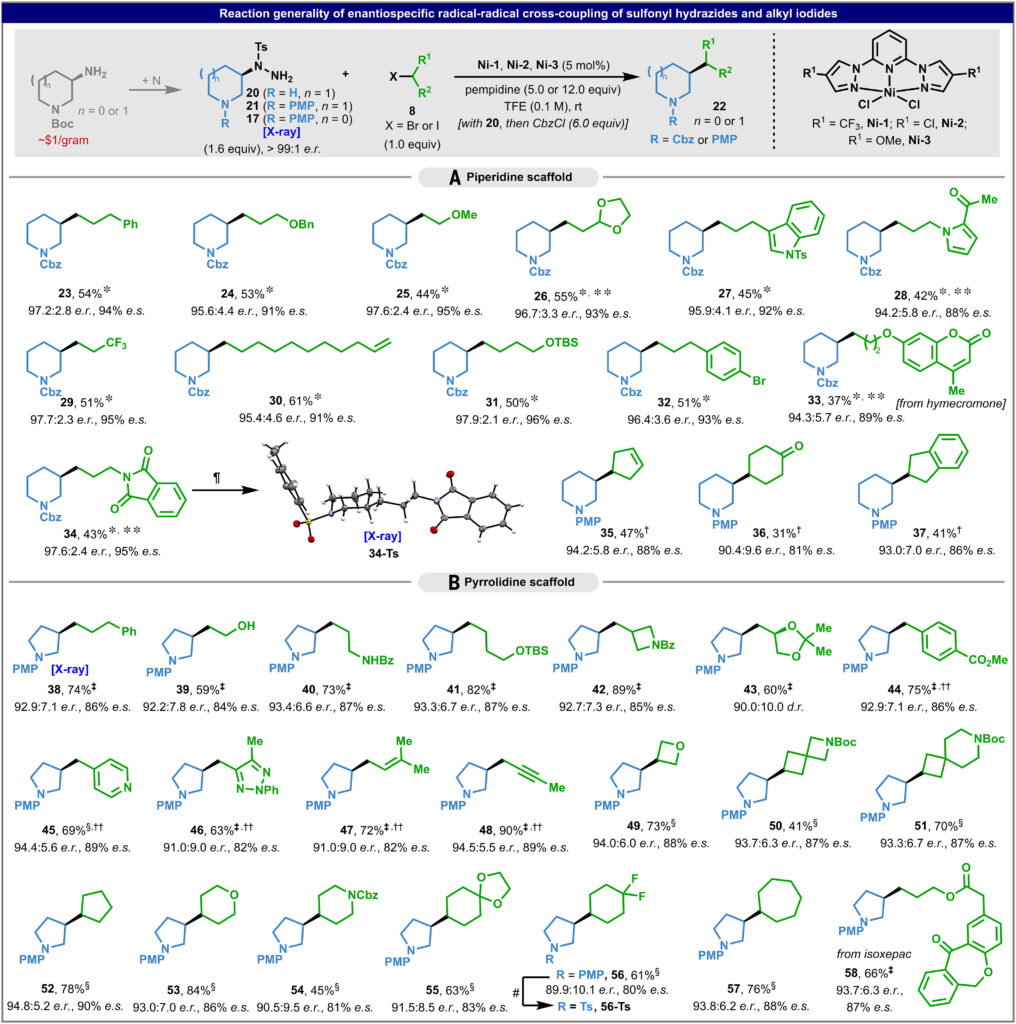
*Using hydrazide 20, Ni-1, 12.0 equiv pempidine. †Using hydrazide 21 and Ni-2. ‡Using hydrazide 17 and Ni-3. §Using hydrazide 17 and Ni-2. ¶Reaction condition: BCl3 (6.0 equiv), DCM, 0°C; then TsCl (1.2 equiv), Et3N (3.0 equiv), tetrahydrofuran (THF):H2O (1:1), 0°C to rt, 67%. #Reaction condition: CAN (3.0 equiv), MeOH:MeCN:H2O (1:1:1), 0°C to rt, then TsCl (2.0 equiv), NaHCO3 (5.0 equiv), DCM, 0°C to rt, 73%. **Reaction run at 45°C. ††Alkyl bromide was used instead of alkyl iodide. CAN, ammonium cerium(IV) nitrate.
Practical real world implications
The authors then demonstrate the utility of this new methodology on real-world scenarios. A piperidine building block en route to NPY-Y1 receptor antagonists previously took seven steps, including a chiral resolution. Here, coupling the corresponding hydrazide with a cheap commercial dihalide provided the molecule in one step (60% yield, 95% e.s.), with nickel picking the iodide over the bromide on its own. The natural product (S,S)-stenusine, whose best earlier route ran six steps, was reached far more directly and on gram scale. And the best part? The hydrazides cost around a dollar per gram, from the chiral pool or routine enzymatic and asymmetric routes.
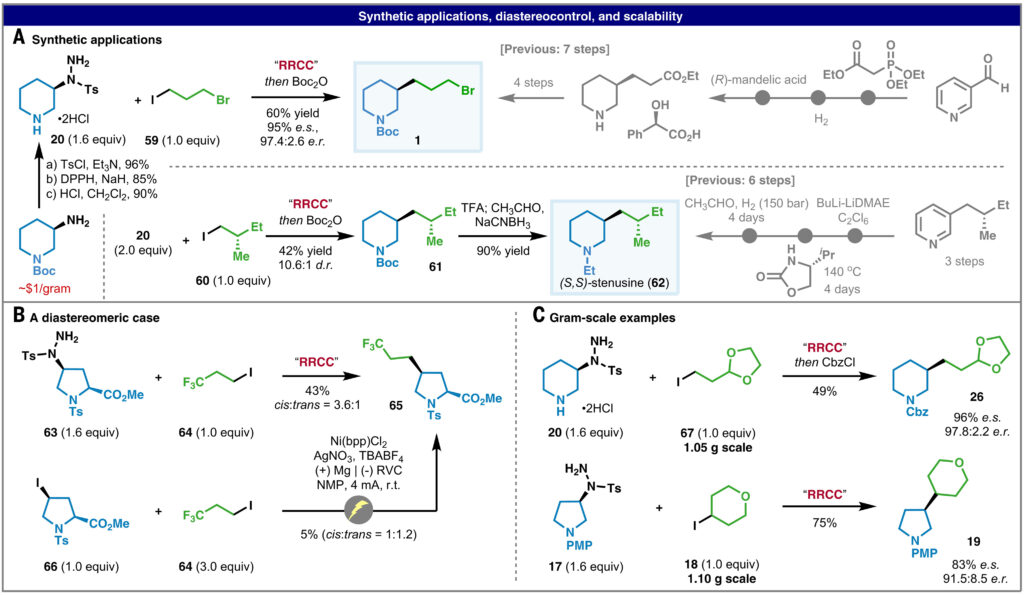
(A) Applications of stereoretentive RRCC to approach drug intermediates and natural products. (B) Diastereomeric studies demonstrate the different reaction outcomes between sulfonylhydrazides and canonical electrochemical coupling using alkyl iodide. (C) Scaled-up RRCC examples forming acetal and pyran-containing products in good yields and enantiospecificities.
Mechanistic evaluation
Radical clock experiments confirm genuine radicals from both partners, and DFT locates the decisive branch point. The fresh radical can either diffuse out of the cage and scramble its configuration, or rebound onto nickel with no barrier while still inside it. Once the nickel-carbon distance drops below about 3 angstroms, rebound wins. This cage rebound, sensitive to temperature and solvent, preserves the configuration. The cycle is redox-neutral, driven by the roughly 30 kcal/mol released when nitrogen gas leaves.
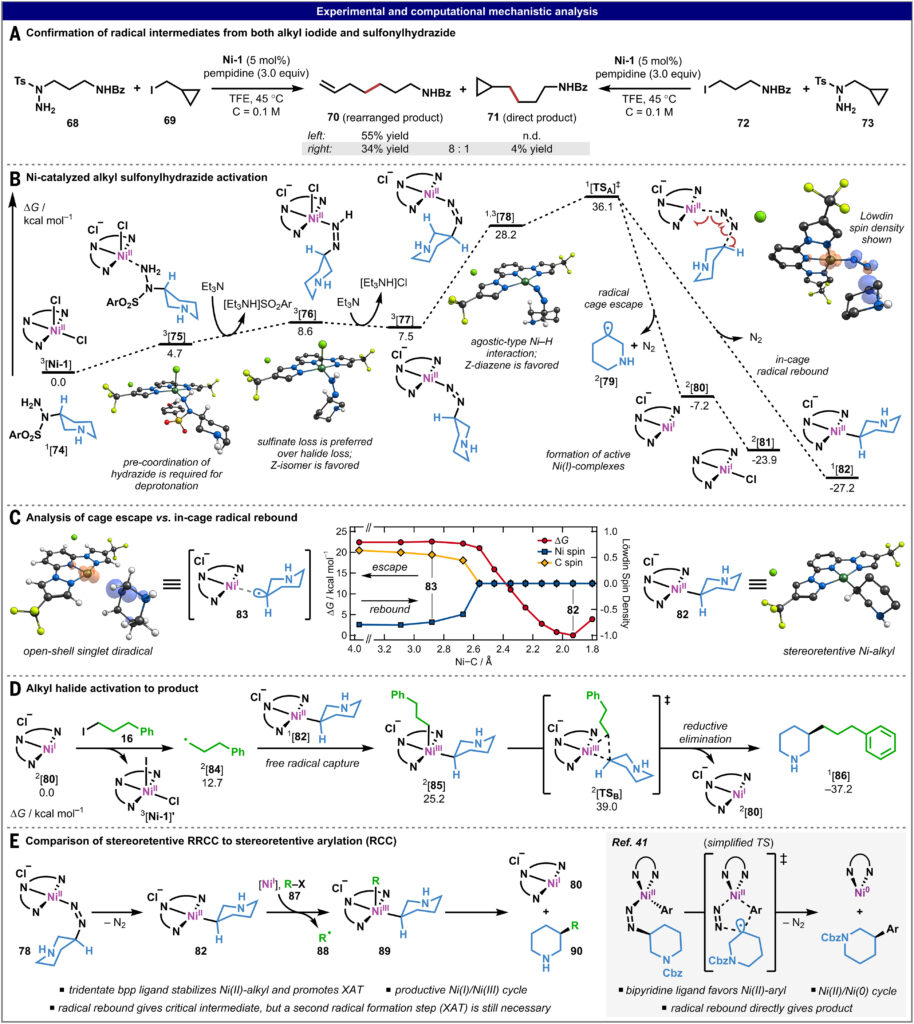
(A) Radical clock experiments confirm a dual-radical pathway. (B) DFT analysis of Ni-catalyzed alkyl sulfolyl hydrazide activation. (C) Investigation of cage-escape versus rebound pathways using relaxed potential energy surface scan and associated Löwdin spin density analysis along the Ni–C bond coordinate. (D) Alkyl halide activation, free radical capture, and product formation. (E) Comparison of the mechanism found in this work with stereoretentive arylation. Optimized geometries found at the (U)TPSSh-D3(BJ) def2-TZVPP(Ni), def2-TZVP, ma-def2-TZVP (Cl, I) CPCM(TFE) level of theory; electronic energies computed with (U)B3LYP-D3B(J) def2-QZVPP(Ni), def2-TZVPP, ma-def2-TZVPP (Cl, I) CPCM(TFE). See the supplementary materials for more details. Computed free energies are given in kilocalories per mole.
My comments
One point worth mentioning is that the method is stereoretentive, not enantioselective. It transfers chirality from an enantiopure precursor instead of creating it, so you still need that building block in hand. The chiral pool of amines and alcohols is, however, vast, so in most instances it shouldn’t be an obstacle. Applicability to other scaffolds might require additional screening for a suitable ligand, protecting group, or conditions, as yields and e.s. can be sensitive to the substrate structure.
Of note, this is not the first work to exploit the solvent cage effect. Another great study recently used the same phenomenon to control asymmetric geminate recasting, and you can read more about it in my LinkedIn post here.
In summary, this research article presents a bona fide scientific story showcasing the first example of a new concept for stereoretentive radical-radical coupling without a chiral catalyst. The core concept rewrites chemistry textbooks, provides thorough mechanistic evaluation and, importantly, also real-world applications where it cuts 6- or 7-steps long synthetic routes to 2 steps, providing optically pure products. On top of that, it requires only cheap and broadly available, bench-stable reagents to produce a potentially large pool of valuable med-chem building blocks. And as it is coming from Baran’s lab, I expect it to reproduce pretty well.
Share your opinion 🧐
Would you reach for this protocol in a medchem campaign, or would the need for an enantiopure hydrazide discourage you? And which sp3-rich targets would you redesign around it?
Leave your comment under my LinkedIn post here.
Full paper: https://www.science.org/doi/10.1126/science.aef6981