PROTAC vs Molecular Glue
It doesn’t happen very often to see a direct comparison of a molecular glue degrader and PROTAC, as it has been just published in J Med Chem:
“𝘋𝘪𝘴𝘤𝘰𝘷𝘦𝘳𝘺 𝘰𝘧 𝘢 𝘚𝘦𝘭𝘦𝘤𝘵𝘪𝘷𝘦 𝘢𝘯𝘥 𝘗𝘰𝘵𝘦𝘯𝘵 𝘉𝘊𝘓6 𝘗𝘙𝘖𝘛𝘈𝘊 𝘸𝘪𝘵𝘩 𝘌𝘧𝘧𝘪𝘤𝘢𝘤𝘪𝘰𝘶𝘴 𝘈𝘯𝘵𝘪𝘱𝘳𝘰𝘭𝘪𝘧𝘦𝘳𝘢𝘵𝘪𝘷𝘦 𝘈𝘤𝘵𝘪𝘷𝘪𝘵𝘺 𝘧𝘰𝘳 𝘵𝘩𝘦 𝘛𝘳𝘦𝘢𝘵𝘮𝘦𝘯𝘵 𝘰𝘧 𝘋𝘪𝘧𝘧𝘶𝘴𝘦 𝘓𝘢𝘳𝘨𝘦 𝘉‑𝘊𝘦𝘭𝘭 𝘓𝘺𝘮𝘱𝘩𝘰𝘮𝘢”
Why it is interesting
✔️ Glue degraders as well as PROTAC are hot topic in the areas of drug development, medchem and chemical biology.
✔️ Both have similar effect (degradation of a target protein) but the drug discovery process differes and both modalities have their advantages and challenging sides.
Some of the key differences
Molecular glues
✔️smaller and typically more druglike
✔️ discovery process requires intensive screening and empirical optimization
✔️ steep and hard-to-predict SAR trends
PROTACs
✔️ typically large molecules
✔️ often suffer from solubility and cellular penetration issues
✔️ Offer modular and more rational design but also require a lot of empirical optimization
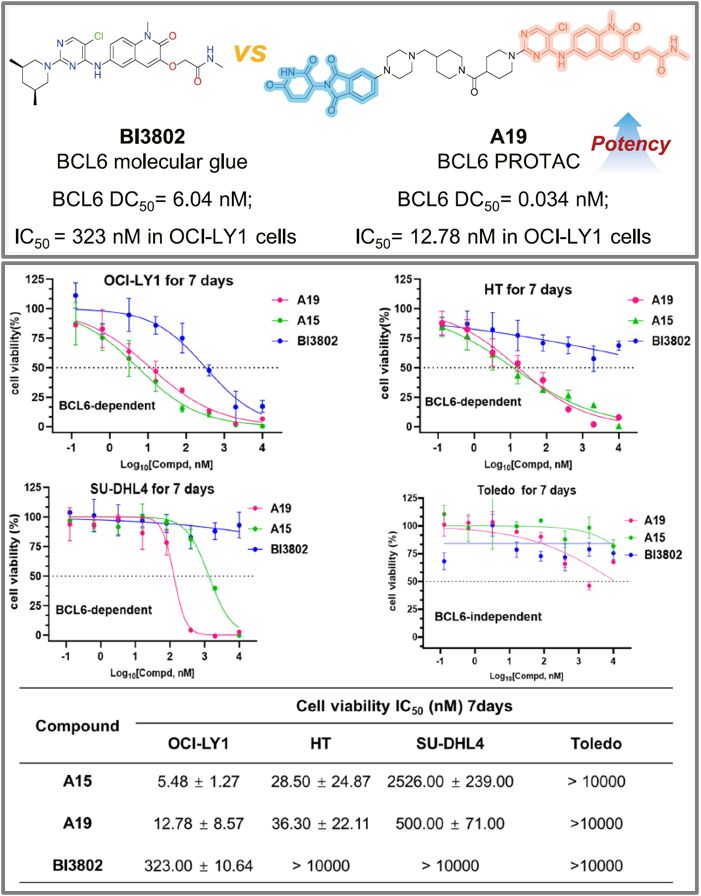
✔️ publication describes developed of highly potent BCL6 degrader (PROTAC A19) and comparison to the known glue degrader BI3802
PROTAC A19 vs molecular glue BI3802
✅ PROTAC A19 achieves sub-nM DC50 (WB)
☑️ BI3802 requires approx. 100 nM concentration to achieve complete BCL6 degradation in both OCI-LY1 and HT cells
(take the numbers with grain of salt – see the plots and blots)
✅ PROTAC A19 demonstrates complete degradation within 1 h
☑️ BI3802 requires 2 h to achieve 90% degradation
✅ PROTAC A19 shows significantly better potency on growth inhibition on BCL6-dependent cell lines (see Fig. below)
✅ RNA-seq: both trigger comparable changes in signaling pathways but PROTAC A19 induced weaker overall gene expression changes relative to BI3802
✅ Mice OCI-LY1 xenografts showed similar tumor growth inhibition
PROTAC A19: 37.2% TGI
BI3802: 36.3% TGI
✅ Both are highly selective on proteome-wide level (CRBN neo-substrates not degraded)
Pharmacokinetics
✅ PROTAC A19: need optimization (fast clearance, short in vivo exposure)
(PO, 30 mg/kg, mice)
Tmax: 2.0 h
T1/2: 2.6 h
Cmax: 407 (ng/mL) (= ca 400 nM)
AUC0‑∞: 2078 (ng/mL·h)
✅PK for BI3802 not determined here but is available at: https://lnkd.in/eR3udw2U
(PO, 100 mg/kg, mice)
Tmax: 4.6 h
Cmax 599 [nM]
AUC: 4650 [nM/h]
Can we say that one modality is better than the other one? Of course not. But this study represents a nice comparison, showing that bigger PROTACs can compete with smaller MG degraders.
Share your insights under my LinkedIn post here.
Full paper: https://pubs.acs.org/doi/10.1021/acs.jmedchem.5c01237