
Nano-PROTACs Are Gaining Traction
The field of PROTACs continues to evolve. A recent Nature Communications paper describes another self-assembling nano-PROTAC that co-degrades androgen receptor (AR) and HSP90 and shows promise for treatment of castration-resistant prostate cancer (CRPC).
To save your precious time, here is my summary and highlights:
Design and mechanism
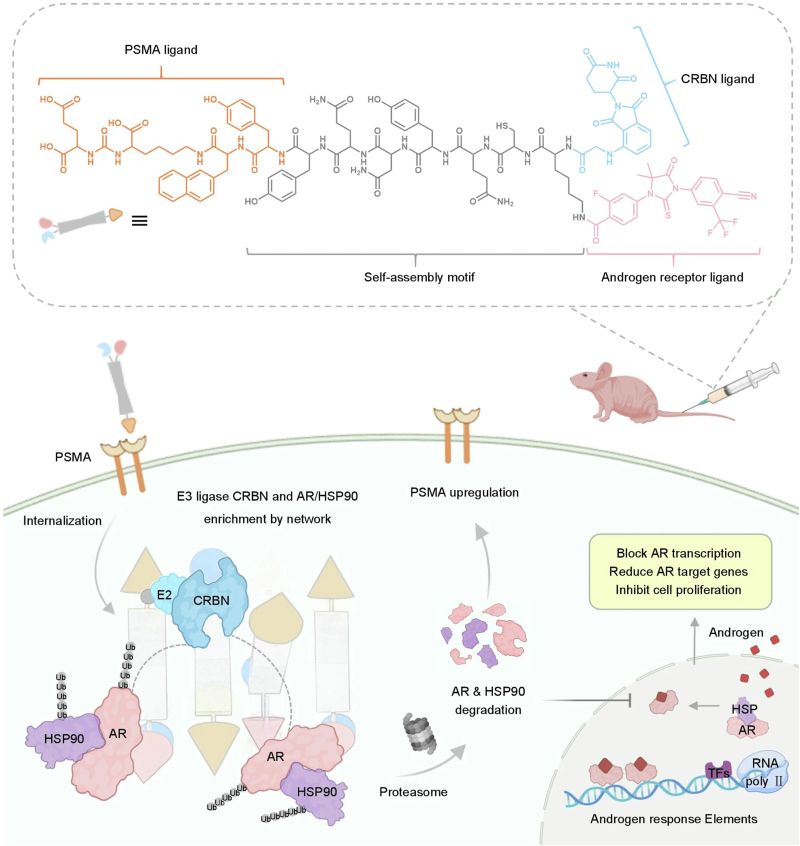
Psa-AR (nano-PROTAC) is a modular peptide comprising:
– A PSMA-targeting ligand (PSMA-617) for tumor specificity
– A self-assembly domain (YYQNYQ) driving β-sheet nanofibril formation upon PSMA binding
– An enzalutamide-derived AR-binding moiety
– A cereblon (CRBN) E3 ligase recruiter
Upon PSMA-mediated internalization, Psa-AR self-assembles into nanofibrils that colocalize AR, HSP90, and CRBN, promoting ubiquitination and proteasomal degradation of both AR and HSP90.
What makes psa-AR interesting
– Precision tumor targeting via PSMA ligand, reducing off-target effects
– Dual degradation: 80% AR, 74% AR-V7 splice variant, and 65% HSP90 clearance in 22Rv1 cells
– Robust in vivo efficacy: 78% tumor growth inhibition and 15-day median survival extension in enzalutamide-resistant xenografts
– Favorable safety profile with minimal systemic toxicity
Why it matters for PROTACs development
Its modular peptide design can be adapted to other tumor antigens and disease targets, paving the way for next-generation, precision PROTACs.
Limitations
– IV administration
– Mechanism of action would deserve better validation
– I would like to see proteom-wide selectivity (MS-proteomics)
– Potency in cellular assay is moderate (10-20 µM)
– Is it really UPS degradation or cytotox effect?
💡Share your perspective
How do you see future of self-assembling Nano-PROTACs? And which disease relevant proteins would you target?
Leave your comment under my LinkedIn post here.
Original research article: https://www.nature.com/articles/s41392-025-02444-z