
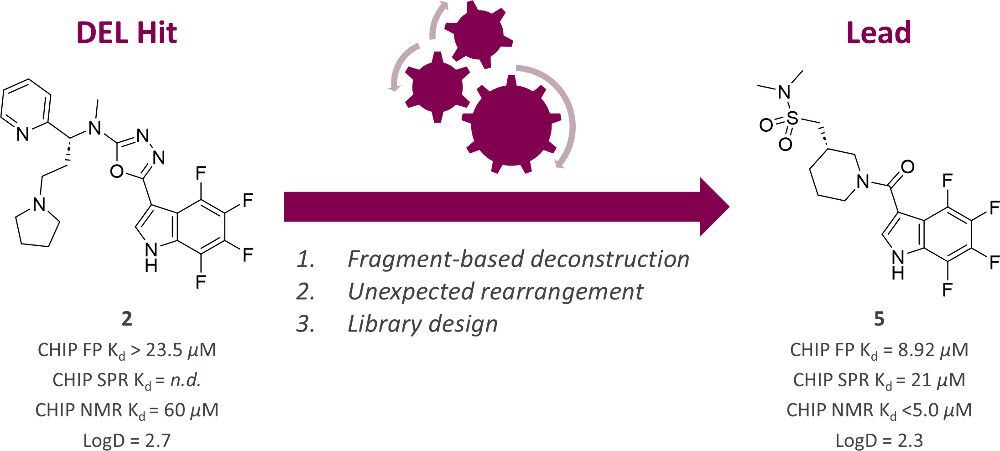
Discovery of Small-Molecule Ligands for the E3 Ligase STUB1/CHIP
Finding potent small-molecule E3 ligase binders is notoriously tough.
Here’s how teams from AstraZeneca, Pharmaron, and X‑Chem collaborated to overcome this challenge and discover a drug‑like ligand for the CHIP/STUB1 protein.
Key highlights
🔬 Background and Significance
– STUB1/CHIP is a U-box E3 ubiquitin ligase that targets misfolded proteins via interactions with Hsc70/Hsp90.
– The currently known peptidic ligands (e.g., CHIP-Opt) have sub-micromolar affinity but poor cell permeability and drug-like properties.
– Expanding the PROTAC toolbox demands drug-like small-molecule ligands targetting novel E3 ligases.
🧬 Hit identification using DEL Screening
– 108 billion compounds ❗ (73 libraries) screened against biotin-CHIP.
– Two hits prioritized
– Hit 1: Kd ≈ 7.7 µM (NMR), 18 µM (SPR), FP
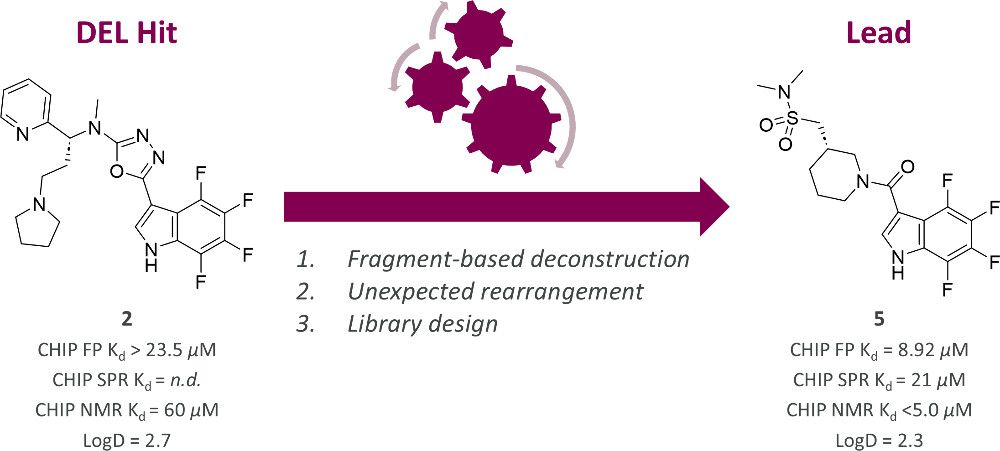
– Hit 2: Kd ≈ 60 µM (NMR)
⚙️ Hit 2 Optimization
– 29 analogues synthesized
– Surprising oxadiazole rearrangement ♻️ gave more potent compound 4.
– Additional 85 analogues were synthesized, among them compound 5 as the most potent ligand
💊 Compound 5:
– Potency: FP Kd ≈ 8.9 µM, SPR Kd ≈ 21 µM, NMR Kd ≈ 5 µM
(NMR and FP data seems to be more relevant and convincing)
– LE ≈ 0.26
– LogD = 2.3
– X-ray structure available (PDB: 9QFY)
My comments:
✅ Compound 5 is first non-peptidic, drug-like CHIP/STUB1 ligand with decent potency.
✅ While further optimization of binding potency would be desirable, with Kd < 10 µM it might already suitable for first exploration of CHIP/STUB1 recruiting PROTACs.
✅ Available co-crystal structure shows potential points for linker attachment
✅ Contains only 1 HBD which is beneficial for favorable physico-chemical properties of corresponding PROTACs.
✅ This story further demostrates the power of DEL screening for identification of hit compounds for hard-to-drug targets.
🧐I am curious about your opinion.
Would you optimize the ligand further or would you directly probe the linker attachment and go for PROTACs development ❓
Are you going to incorporate this ligand into your PROTACs ❓
Link to the full article: https://pubs.acs.org/doi/10.1021/acsmedchemlett.5c00361
Leave your comment under my LinkedIn post here.
hashtag#E3Ligase hashtag#PROTACs hashtag#DrugDiscovery hashtag#DEL hashtag#TPD hashtag#MedicinalChemistry hashtag#Biotech