
Cracking the Oncogenic Star Player KRAS
KRAS has been in the focus of cancer research for quite some time as it has been recognized as a key driver of tumor growth in several human cancers.
In recent years, scientists could target inactive KRAS forms (like G12C). However, targeting the active-state mutations (such as G12R, Q61K, Q61L, Q61 variants) remained elusive, partially due to the competition with potent GTP binding.
Teams of Alessio Ciulli, Kirsten McAulay and Peter Ettmayer, just reported ACBI4, a panKRAS degrader capable of targeting the main cancer-relevant KRAS variants.
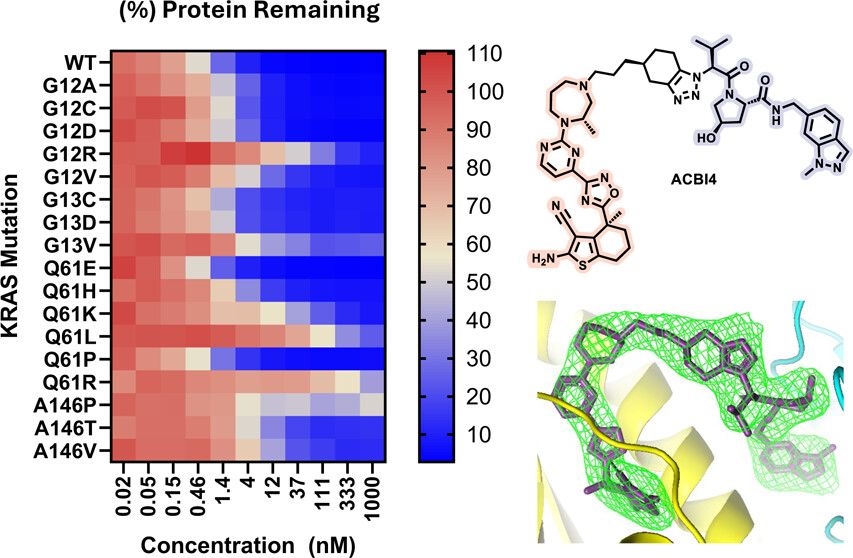
ACBI4 properties
– Very high cooperativity values: α = 143 for KRAS(G12D) and α = 106 for KRAS(G12R)
– Long ternary complex half-live (~55 minutes for KRASG12D variant)
– Potent degradation of all 17 major KRAS variants,
e.g. KRAS(G12R): DC50 = 162 nM and Dmax = 93% (at 18 hours)
– Selective: Targets KRAS while sparing closely related proteins, potentially offering a wider therapeutic window (based on MS-proteomics), ~2-fold selectivity over HRAS
Additional highlights
– What I find interesting is the innovation in the design of VHL ligand which goes behind the common VHL binders in the literature.
– The manuscript also reports co-crystal structures of ternary complexes, which is something still relatively scarce in the PROTAC literature.
– The high potency seems to be driven by the high thermodynamic and kinetic stability of the ternary complex.
And the best part? The PROTAC ACBI4 can be obtained free of charge from OpenME platform!
Share your opinion
What is the next emerging therapeutic target you would suggest to target with small molecules?
Leave your comment under my LinkedIn post here.
The full paper: https://pubs.acs.org/doi/10.1021/jacs.5c10354