
Are Alpha Emiters the Future of Radiotherapy?
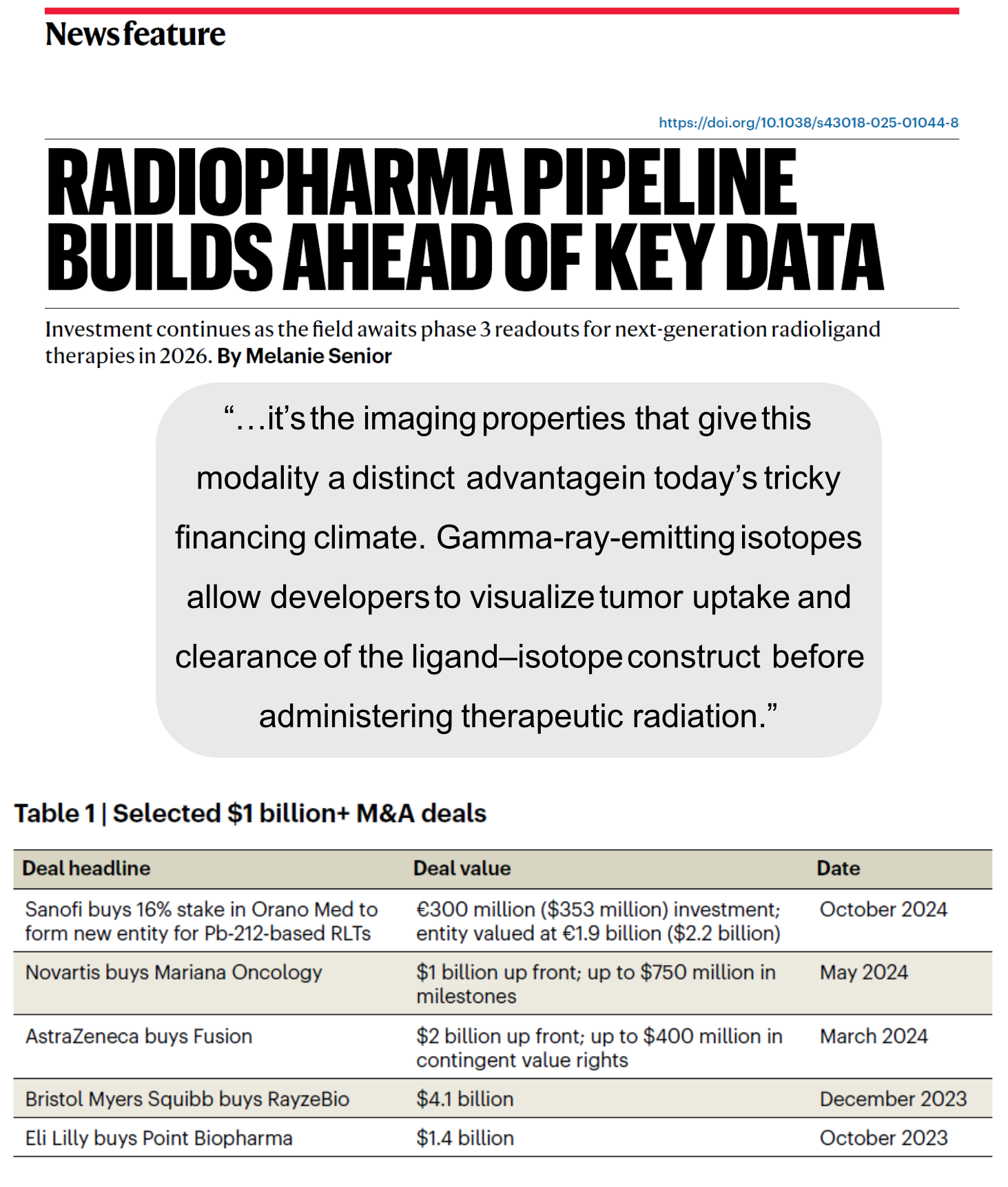
While biotech faces a funding downturn, radioligand therapy (RLT) is attracting major investments. The field stands at an important inflection point as next-generation alpha-emitting therapies prepare for phase 3 readouts in 2026.
Why investors are betting on RLTs
✔️ Imaging-guided development enables visualization before treatment
✔️ Physical, rather than pharmacological, cancer-killing mechanism
✔️ Unprecedented speed: candidate selection to patients within 12 months
Isotope landscape
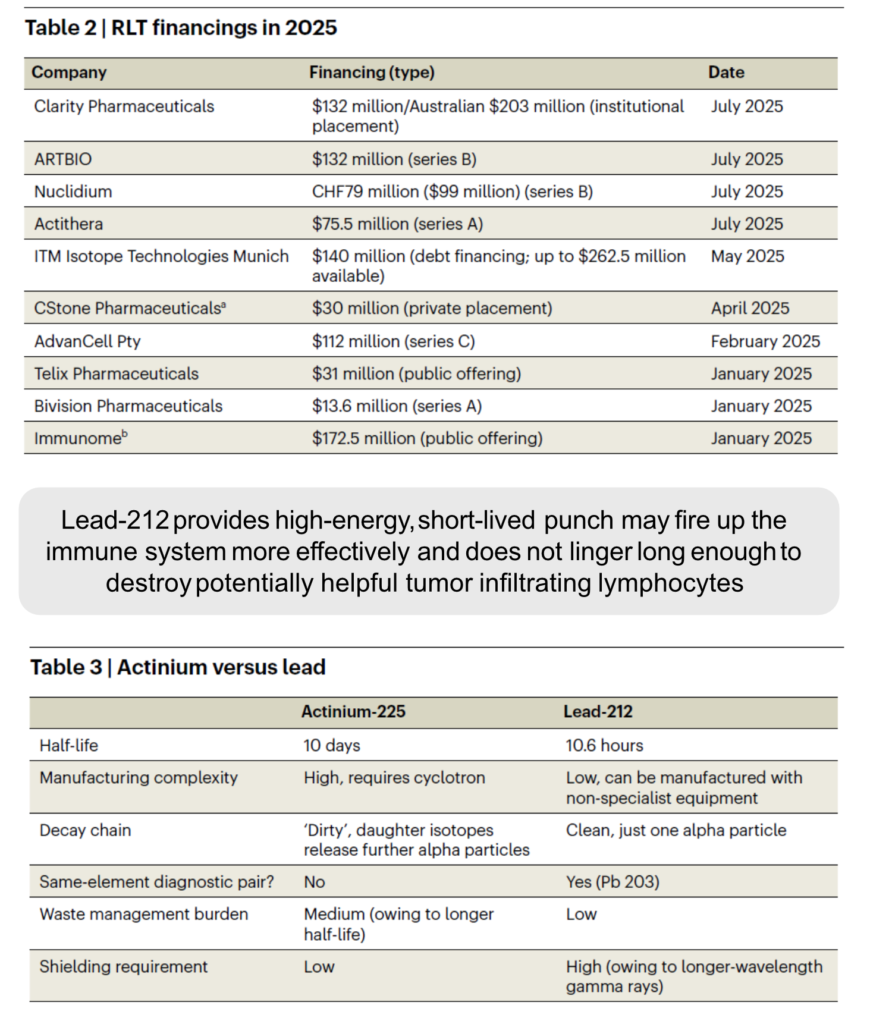
🔸 Ac-225 and Pb-212 are the front-runner alpha emitters. (see Table 3 below)
🔸 Beta-emitting Lu-177 remains a prominent isotope
🔸 Other isotopes are being explored: iodine-123, rhenium-186, copper-67, terbium-161
Advantages of alpha emiters
✅ Unlike current beta emitters, alpha radiation (Ac-225 and Pb-212) causes more double-strand DNA damage, potentially delivering more effective cancer-killing effect with reduced treatment resistance.
✅ High linear energy transfer (LET): Delivers a concentrated, high-energy “punch” over a few cell diameters, minimizing off-target toxicity
✅ Short tissue penetration: Alpha emitters’ ~50 – 100 µm path length confines damage to tumor cells, sparing surrounding healthy tissue.
✅ Immunogenic potential: The brief, intense radiation burst may stimulate anti-tumor immunity without depleting tumor-infiltrating lymphocytes, unlike longer-lived beta emitters.
✅ Reduced cross-fire effect: Limited range avoids collateral damage in heterogeneous tumors, making them ideal for small or micrometastatic disease.
✅ Orthogonal mechanism: Provides a physical (radiation) modality distinct from pharmacological drugs, enabling combination with chemotherapies or immunotherapies without overlapping resistance pathways
2026: Important milestones for alpha emiters
Two pivotal phase 3 results will define the field’s future:
🔸 Bristol Myers Squibb’s RYZ101 (Ac-225-based)
🔸 Sanofi/Orano Med’s AlphaMedix (Pb-212-based)
Target and ligand expansion
Ligands represent the next big area of growth and innovation in RLTs, with the goal being ligands that bind selectively and tightly to cancer-specific targets, stay around long enough to deliver an effective payload and aren’t retained in the kidneys.
RLT market potential
Forecasted at $6.5 billion by 2030
Which alpha emiter do you think has better potential?
Leave your comment under my LinkedIn post here.
Original full paper: https://www.nature.com/articles/s43018-025-01044-8