Let’s Hijack DCAF2 for TPD?!
Well, not quite yet. But maybe soon.
Frontier Medicines evaluated E3 ligase DCAF2 (DTL/CDT2), as a novel ligase for targeted protein degradation by PROTACs (published in 𝘚𝘵𝘳𝘶𝘤𝘵𝘶𝘳𝘦):
“𝘚𝘵𝘳𝘶𝘤𝘵𝘶𝘳𝘢𝘭 𝘣𝘢𝘴𝘪𝘴 𝘧𝘰𝘳 𝘋𝘊𝘈𝘍2 𝘢𝘴 𝘢 𝘯𝘰𝘷𝘦𝘭 𝘌3 𝘭𝘪𝘨𝘢𝘴𝘦 𝘧𝘰𝘳 𝘗𝘙𝘖𝘛𝘈𝘊-𝘮𝘦𝘥𝘪𝘢𝘵𝘦𝘥 𝘵𝘢𝘳𝘨𝘦𝘵𝘦𝘥 𝘱𝘳𝘰𝘵𝘦𝘪𝘯 𝘥𝘦𝘨𝘳𝘢𝘥𝘢𝘵𝘪𝘰𝘯”
Why it is important
✅ This work addresses a key limitation in PROTAC development: the narrow pool of E3 ligases that we can hijack by a suitable small molecule ligand.
✅ DCAF2 is overexpressed in various cancers, potentially enabling tumor-selective degradation strategies.
Key findings
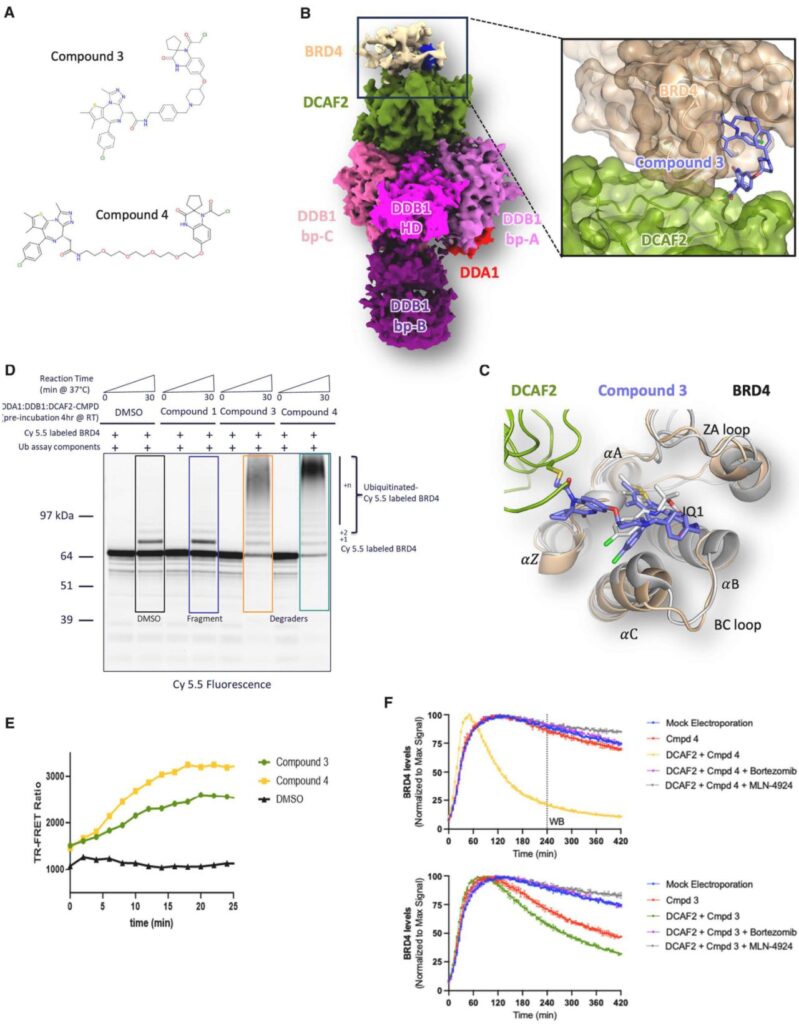
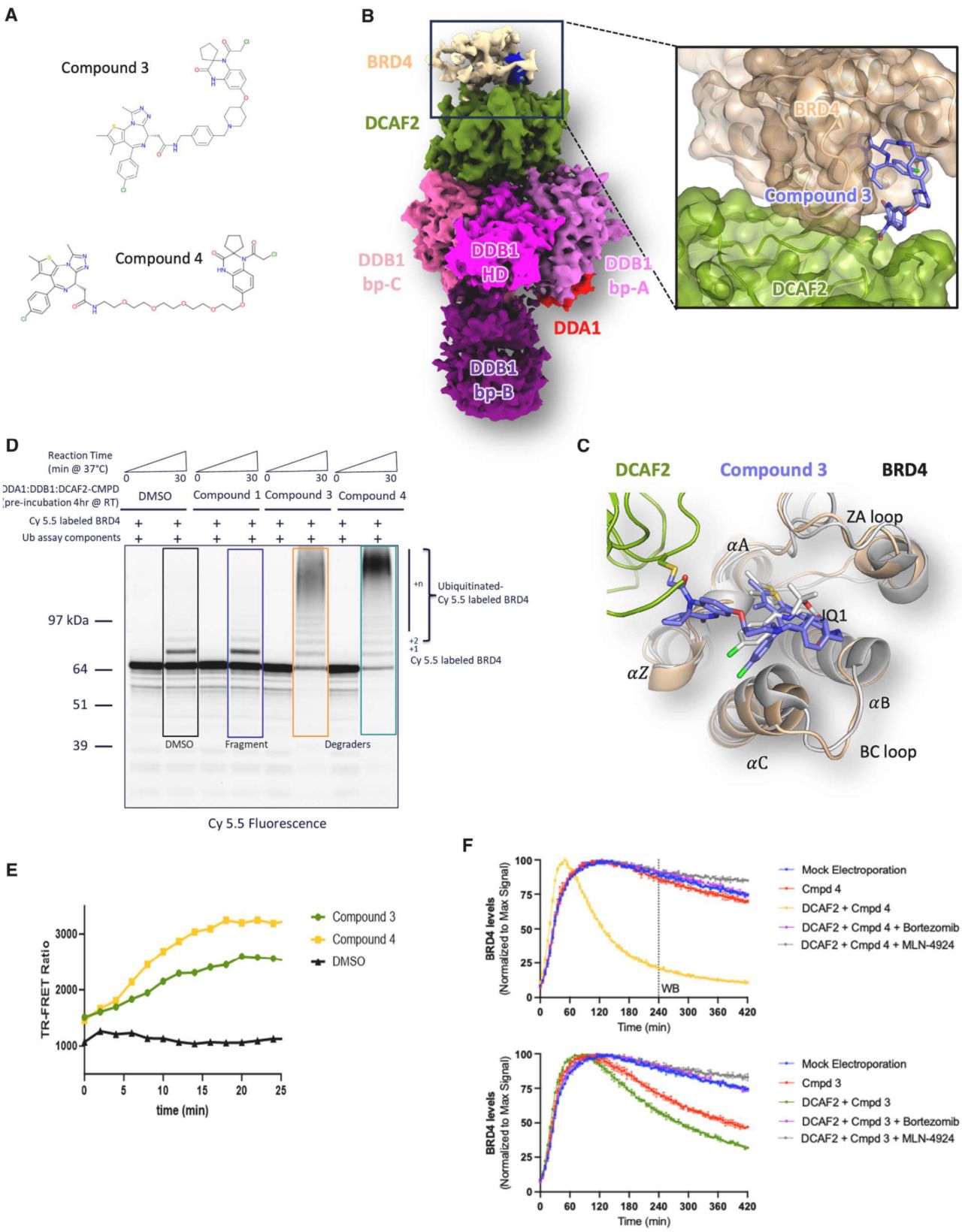
✔️ Two chloroacetamide fragments (compounds 1 and 2) form covalent bond with C141, confirmed by intact MS, peptide mapping and C141A mutagenesis (Fig. panel A)
✔️ Covalent ligand 1 was linked to JQ1 (BRD4 ligand), resulting in bifunctional compounds 3 and 4 that successfully catalysed BRD4 ubiquitination in vitro (Fig. panel D)
✔️ Smuggling purified DCAF2:Compound 3/4 adduct into cells (via electroporation) resulted in cellular BRD4 degradation (Fig. panel F)
✔️ Cryo-EM reveals structure of ternary complex (DCAF2:DDB1:DDA1:Compound-3:BRD4-BD1) at 3.4 A˚ resolution (Fig. panel B)
My comments
🔸 This work is a significant step towards validation of DCAF2 as potentially valuable E3 ligase for TPD by showing that DCAF2 can ubiquitinate neo-substrates, leading to degradation.
🔸 However, there are still major limitations: Smuggling into cells high concentration of DCAF2 which is covalently pre-modified with small molecule is very different from hijacking the endogenous DCAF2.
🔸 Selectivity of these covalent ligands in cellular environment in unknown and I would bet that highly reactive chloroacetamide will need to be replaced by a milder covalent warhead (to balance potency and selectivity).
🔸 Finding potent and selective DCAF2 ligand that is suitable for PROTAC development might take a while, but this work provides a great foundation for further medchem optimization.
What’s your take?
How would you optimize the DCAF2 ligands further?
Do you see DCAF2 as promising E3 ligase for PROTAC-induced TPD?
Leave your comment under my LinkedIn post here.
Full Article: https://doi.org/10.1016/j.str.2025.09.006