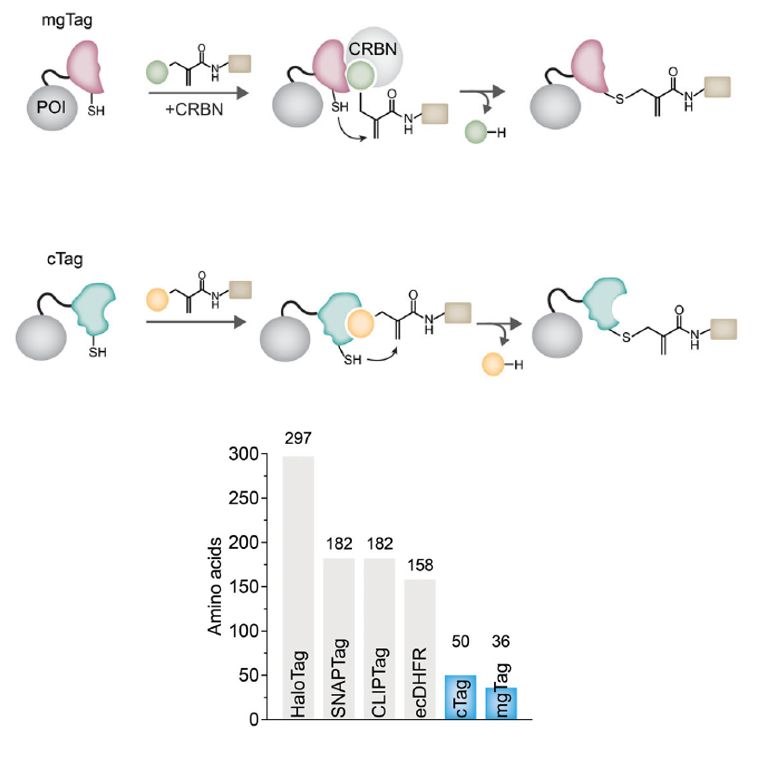
Introducing mgTag and cTag
How do you study the 90% of proteins that lack small-molecule binding partners? By tagging the protein!
The problem is that most tags are too bulky, like trying to study a butterfly 🦋 with a bowling ball attached.
To address this limitation, researchers at the Broad Institute developed two novel protein tags which were published in Angewandte Chemie:
“𝘜𝘭𝘵𝘳𝘢𝘴𝘮𝘢𝘭𝘭 𝘊𝘩𝘦𝘮𝘰𝘨𝘦𝘯𝘦𝘵𝘪𝘤 𝘛𝘢𝘨𝘴 𝘸𝘪𝘵𝘩 𝘎𝘳𝘰𝘶𝘱-𝘛𝘳𝘢𝘯𝘴𝘧𝘦𝘳 𝘓𝘪𝘨𝘢𝘯𝘥𝘴”
My highlights
Size:
🔸 mgTag: 36 amino acids
🔸 cTag: 50 amino acids
✔️ Both tags use “transferase-type reactivity” (exploiting the same mechanism cells use naturally) ➡️ allowing attachment of any moiety-of-interest to the tag ❗
✔️ The mgTag operates through a molecular glue system requiring cereblon (CRBN)
✔️ cTag uses an engineered C1 domain from protein kinase C
✔️ The smallest covalent chemogenetic tags developed to date
✔️ Both tags are of human origin: suitable for applications requiring reduced immunogenicity
This technology can find applications in basic science, proximity inducing modalities, biotechnology, and medicine, including potential use in CRISPR-based knock-in technologies and synthetic biology applications.
Share your opinion
What applications do you see for these novel protein tags ❓
Share your thoughts in comments below.
Leave your comment under my LinkedIn post here.
Full manuscript: https://doi.org/10.1002/anie.202506997Digital Object Identifier (DOI)